

The Carbon Footprint of Formula One
Formula One motor car racing (F1) may not be the sport that comes to mind when you think of clean or low carbon pastimes. So you might be surprised to learn that in 2019 F1 announced its intention to be Net Zero by 2030. Every team has started using 100% sustainable fuel in 2026 and will use hybrid engines that will be 50% electric (Changing to 40% in 2028).
Where do Formula One’s emissions come from?
Formula One’s emissions don’t just come from the cars racing around the track each weekend. They also come from F1’s HQ, the production of the cars, the transportation of the cars and teams around the world for each race, the race organisation and catering, spectator travel to and from races and from television broadcasting too. The list is long.
Formula One calculated their carbon emissions to be 228,793 tonnes of CO2e in 2018. By 2024, these emissions had reduced to 168,720, split into the following categories (they don’t currently include spectator travel):
The governing body’s emissions
In 2025 the FIA (motorsport’s governing body) had a carbon footprint of 28,337 tonnes of CO2e. Compared to the baseline of 2022 it has increased by around 30%. They offset these emissions in 2022 and 2023 to call themselves carbon neutral. But the FIA has committed to reducing the emissions of its own operations by 50% by 2030. So they are currently way behind their target.
In fact the FIA have shown over the 4 years from 2022 to 2025 there emissions have always increased and with roughly 300 employees have one of the highest “Average carbon footprint per employee” at a staggering 87 tonnes of CO2e. A normal average for one of our clients is 3 tonnes.
The teams’ carbon footprint
Not all teams are equal when it comes to addressing their carbon footprint (or at least communicating on it).
Merccedes: mid grid
AMG Petronas have confusing targets. By 2030 they are aiming for part of their business to be Net Zero (90% reduction) and other parts of the business hitting this target in 2040. Their 2025 carbon footprint suggests no progress since 2022. In fact I would argue it has increased.
They have gone big on sustainable aviation fuel purchases to reduce travel emissions but I worry about their emissions from purchased goods, the largest source of emissions by far.
It’s really positive to see they are assessing our carbon footprint to industry benchmark standards in line with the Greenhouse Gas Protocol Guidance and SBTi framework, including full scope 3 emissions reporting. Other teams: take note!
Williams: jump start
The Williams team is favouring a ‘net zero carbon footprint by 2030, using the definition of at least a 50% reduction in carbon emissions’ strategy meaning they do not understand “Net Zero.
The do well in sharing some of their carbon figures, showing a wonderful 13% reduction in emissions from 23 -24.
The missing baseline year emissions make me suspicious though that the big picture is not positive. They also seem to be missing quite a lot of Scope 3 emissions. Other companies suggest that they could therefore be considerably underestimating their emissions.
Ferrari: mid-grid
Ferrari (as a whole company) measured and shared their footprint in 2026. Figures are positive compared to the year before. No idea how they compare to their baseline year, they are a bit vague on the details there.
Top marks for measuring most of Scope 3 but the strategy seems lacking. They used to say they were going for SBTi, that no longer seems to be the case.
Never has a report been so hard to read and boring. For a company focused on design and style, their sustainability team is very boring.
Aston Martin: Rising up the field
Aston Martin have really improved what they share transparently online. Like Ferrari their figures are for the whole car company. Results show emissions have stayed the same over the last 3 years. But their targets are clear and make sense. Their reflections and actions also make sense (in the short term at least)
Red Bull: Currently being lapped
Good news, Red Bull now have new hand dryers in their Milton Keynes HQ. There is a real lack of key info here. There is a commitment to get emissions down by 2030 but no figures that I can find.
What can your business learn from F1’s Net Zero journey?
Hindsight is useful, certain things worked well and some things have created extra work with little to show for it.
But here would be our takes on how your business can end up with a better climate story to tell:
An ambitious target without a plan is bound to fail. F1 has constantly changed their climate target all whilst CO2 emissions have stayed the same. Ecollective’s approach is to measure emissions first, look for reduction strategies that are viable and then curate a target in line with what is realistic.
Measure the full carbon footprint (scope 1, 2 & 3) from the start. Many of the F1 teams are struggling to measure more each year whilst also report on Co2 reductions.
We have the technology and ideas already to reduce CO2e and save money. The reductions that have been made by the sport have had a positive impact on the business. Measuring and Reducing your carbon footprint isn’t done to be nice to the planet, it leads to be better financial results.
Pushing technological boundaries
Formula One has been committing energy and resources to developing new technologies which have benefits far beyond decarbonising their own activities. Creating the world’s most efficient engines is one obvious benefit that trickles down into the automobile industry but other developments can be surprising. For example, the F1 team, Williams, developed a solution they sold to supermarkets that reduces the energy consumption of their fridges through the application of aerodynamic theory.
Sustainable fuels
Another technology being advanced by F1 is fuel that has a smaller carbon footprint (which the industry is calling ‘sustainable fuel’). In 2026 cars will run on this new blend which will come from a combination of carbon capture, municipal waste or non-food biomass. It has a 65% emissions reduction compared to fossil fuel sourcing and production. In theory, this should also be fit for use in regular cars without requiring any engine updates.
Remote Broadcast Operations
F1 has taken a giant leap forward to reduce its television production carbon emissions. By basing a large part of their production team permanently in Kent, UK, they have reduced the number of personnel and amount of equipment that needs to travel around the world to each event by a third. This is an approach which could and should be used by other sports too.
The Formula One schedule
The competition calendar has been criticised for its race schedule which is terribly designed.
This is the 2023 schedule in the order the events will take place so you can see for yourself:
Bahrain - Australia - Azerbaijan - US (Florida) - Italy - Monaco - Spain - Canada - Austria - UK - Hungary- Belgium - Netherlands - Italy - Singapore - Japan - Qatar - US (Texas) - Mexico - Brazil - US (Nevada) - Abu Dhabi.
Since then there have been some improvements which has led to reduction in CO2.
But the question remains. Currently the schedule is more circuitous than the Monaco circuit and begs the question: why not group races by continent?
If you manage events or venues and want to reduce your carbon footprint, see how Ecollective’s free guide on how to start measuring and reduce your carbon footprint.
Sponsors
With hindsight Formula One has a pretty chequered history when it comes to sponsors. Pre-2007, the sponsorship was dominated by tobacco brands (remember Marlboro or Lucky Strike plastered across the spoiler of the cars?) These days, with tobacco advertising banned, sponsors are spread across a variety of industries from recruitment (Randstad) to IT hardware (Logitech) to watches (Rolex). One of the main sponsors this year (and until 2027) is Qatar Airways. This doesn’t seem a great fit when the sport is apparently on a mission to decarbonise.
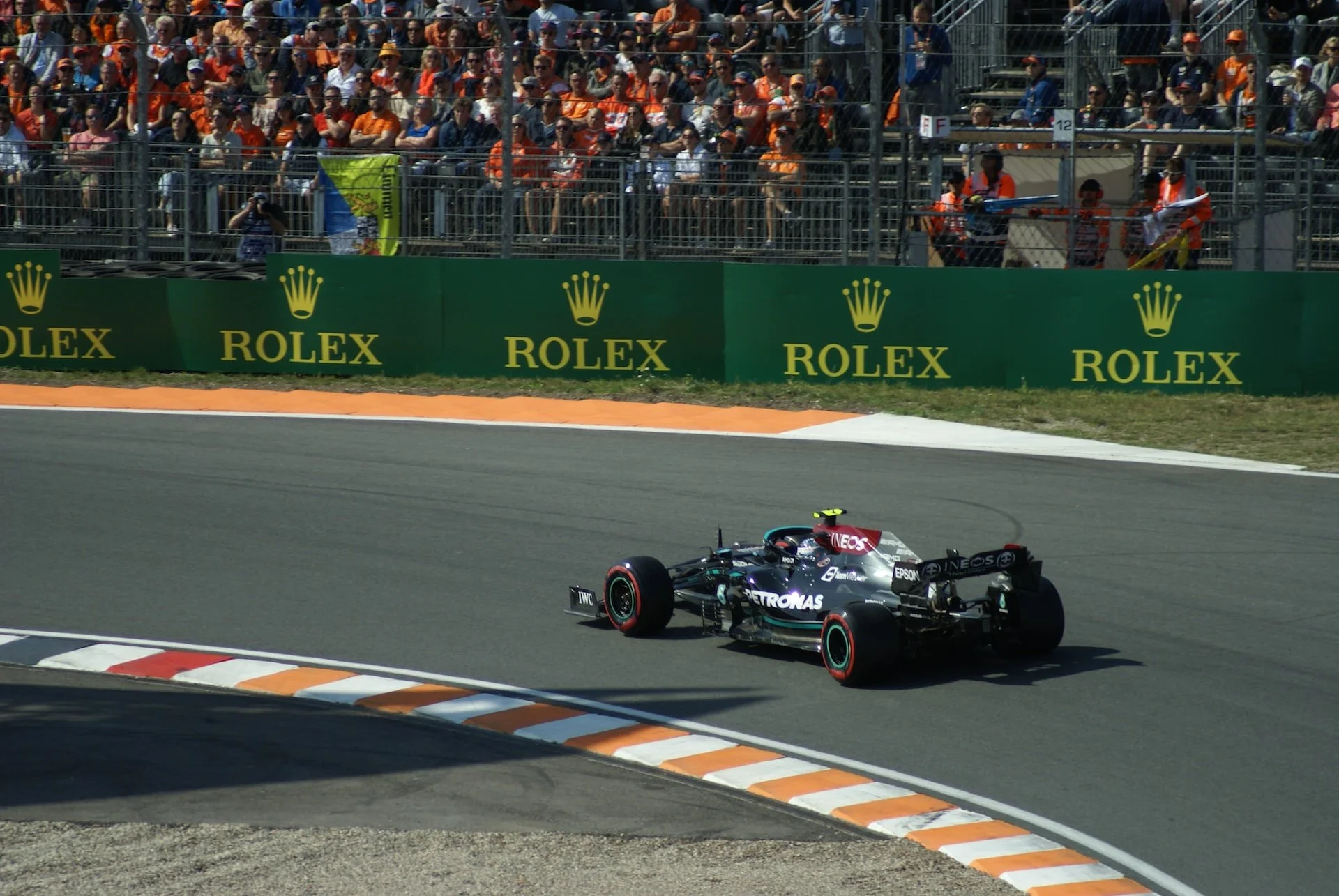
Rolex sponsor Formula 1 racing
A focus on tyres
It’s not just Formula One that is addressing its environmental impact. Tyre manufacturer Pirelli is also racing ahead. They are transitioning to renewable energy. They are working to deliver their products using the most efficient trucks too.
The tyres themselves are made from natural rubber that does not cause deforestation. To test them, Pirelli are relying more and more on computer simulation to conserve resources. At the end of their life, tyres are broken down into chemical components for use in other products or granulated to make playgrounds and athletic tracks.
How can Formula One reduce its emissions?
Well there are lots of opportunities out there and some great examples to copy from (Sail GP and Extreme E being great examples). They could:
aim to reduce fuel amounts required by each racing car
introduce stricter spending caps on the amount teams can spend on new parts
mandate team travel emission caps or budgets
take aerial video footage using drones instead of helicopters (ski racing does this effectively)
host races near where the majority of fans are based to reduce visitor travel emissions
re-use old tracks instead of creating new ones
design the competition calendar for minimal transfer distances
Besides decarbonising their car engines and moving to sustainable fuel (which they are already doing) the biggest opportunity in our eyes is the competition calendar. Streamlining this so teams travel the shortest distances possible between events will dramatically reduce the carbon footprint of the sport.
What would ecollective do?
If we were given the chance to pitch to help F1 decarbonise, we would start by measuring ALL of the associated emissions to the best degree of accuracy we could (including those of all the teams). With this data we would be able to identify the key areas for reduction and set a tough but achievable Net Zero target. We would accompany the target with some focused actions to help them achieve it and build them a tool to help them keep track of their progress.
If you’re interested to find out how your company can decarbonise its operations in this way, drop us a line.
