

The Carbon Footprint Of Holidays
Which Vacations are the best in the eyes of carbon expert.
Not all holidays are created equal, especially when it comes to their carbon footprints. Some trips leave a heavier mark on the planet than others. Let's explore which holidays are the most and least carbon-intensive.
In this article, we carbon label and categorise 10 types of holidays into high, medium and low carbon emissions and explain where the emission hotspots generally are. Then we’ll put forward our vision for how holiday companies can start to influence customer choice towards lower carbon options.
With tourism responsible for roughly 8% of carbon emissions, it’s clear we need to take action now, before there is nowhere left worth visiting.
Note: we haven’t included food in the calculations as these would be similar for all trips and wouldn’t aid the comparison. We are London based carbon consultants, so all trips start from here.
High-Emission Holidays: Trips That Pack a Carbon Punch
These are holidays that create more than 2 tonnes of GHGs per person.
Antarctic Cruise (14 days) - 8.4 tonnes of CO2e per person
This trip tops the list of the highest emitting holidays. Included in our assumptions are flights to Ushaia on the southern tip of Argentina via Buenos Aires, a short taxi transfer and accommodation on the ship. Transport is usually the highest emitting element of any holiday and the reason this is so high is simply because you’re constantly moving. Ironically, every cruise of this type is responsible for melting around 3.3 kilometres of sea ice.
💡 Carbon emitted for a family of four: 33.6 tonnes of CO2e
Long Haul Ski Trip (7 days) - 2.3 tonnes of CO2e per person
Skiing itself is not a very carbon intensive activity (phew). The difference is which country you ski in. That means the main carbon hotspot for this trip is the flight to the US from the UK. As you’ll see later in the article, skiing in the French Alps has a significantly lower footprint, so hitting the slopes is still possible.
💡 Carbon emitted for a family of four: 9,2 tonnes of CO2e
Kenyan Safari (7 days) - 2.2 tonnes of CO2e per person
We’ve included return flights to Nairobi, accommodation, one internal flight and 3 jeep safari days. The flights are the biggest emitting part of this trip creating 74% of the overall emissions, but by taking part some of your money may go towards conservation if spent right.
💡 Carbon emitted for a family of four: 8.8 tonnes of CO2e

A trip to Disneyland Florida falls into the high emitting holiday category.
Disneyland Florida (7 days) - 2.15 tonnes of CO2e per person
Taking the kids to Disneyland, Florida falls in the high category mainly because of the flights involved to get there. With accommodation and theme park based activities only represent about 5% of the total carbon footprint, choosing the right activities and accommodation could bring your Florida adventure below the 2 tonne mark. And, no, we didn’t calculate the emissions of those Mickey Mouse ears.
💡 Carbon emitted for a family of four: 8.6 tonnes of CO2e
What can travel companies do?
We know that not everyone will be convinced by a staycation. We also believe that travel is important for broadening minds, horizons and having new experiences. That being the case, we’d like to advocate for all travel agencies and holiday companies to take a leaf out of Hilton Hotels’ book. To reduce the carbon footprint of their restaurants, they overhauled their menus and did these three simple things:
Carbon labelled all dishes.
Categorised the dishes (as we have done with the holidays above) into low, medium and high emitting options.
Reduced the number of high emitting dishes so 85% of the menu falls in the low and medium range.
The result is that diners are nudged towards, and have actually chosen, lower carbon options.
Now, what if holiday companies did the same? Several operators have already started carbon labelling trips. Disappointingly, travel to the destination is often not included and, when travelling abroad, that’s nearly always the highest proportion of a trip’s carbon emissions. This has to change. But done right, this approach could educate and nudge holiday-makers into making lower carbon and more sustainable choices.
How would you go about this? Easy.
Measure the carbon footprints of your trips.
Find the smartest way decarbonise your trips. The challenge for every business is to create happy customers with a smaller and smaller footprint every year.
So what do you say? Are you ready for the next step? If so and you need help, we’ve measured the carbon footprint of thousands of holidays and can work alongside you to decarbonise your itineraries.
Medium emitting holidays
Holidays in this bracket could still be called holidays of a lifetime and represent wonderful experiences, but come in at between 1-2 tonnes of CO2e per person.
Jordan group tour (7 days) - 1.4 tonnes of CO2e per person
Visiting the ancient city of Petra, swimming in the Dead Sea and experiencing the Bedouin culture is pretty spectacular and comes with a smaller carbon footprint than the trips above. This is thanks to a medium length flight and overground shared transport. Group tours like this can be a great way to cut transport emissions.
💡 Carbon emitted for a family of four: 5.6 tonnes of CO2e
Beach holiday in Greece (7 days) - 0.94 tonnes of CO2e per person
Pack your bucket and spade for a holiday of sun, sand and ouzo and your carbon footprint will be half that of a trip to Disneyworld. We’ve included flights and accommodation because topping up your tan, playing beach ball and building sandcastles is about as low carbon as holiday activities get. The carbon emissions are relatively high due to the distance flown and the higher carbon intensity of accommodation in Greece which can be explained by how they create electricity and the amount of air-conditioning.
💡 Carbon emitted for a family of four: 3.78 tonnes of CO2e
Low emitting holidays
If you’re watching your carbon footprint then these are some trips to help you stay within budget. These holidays all have a carbon footprint of less than 1 tonne of CO2e per person.
Danube river cruise (7 days) - 0.84 tonnes of CO2e per person
Want the luxury and relaxation of cruising without the massive carbon footprint? River cruising could be for you. Visit stunning European cities including Budapest, Salzburg and Vienna aboard a floating hotel for a half of the emissions of a flight from London to San Francisco. We’ve included flights and accommodation on board and assumed visits will be on foot.
💡 Carbon emitted for a family of four: 3.36 tonnes of CO2e
Rome city break (7 days) - 0.45 tonnes of CO2e per person
Visit the piazzas of the ‘Eternal City’, picture the battles at the Colosseum and check out the Sistine Chapel in the Vatican City. Included in our calculations are flights from London, accommodation, the odd taxi and daily sight-seeing activities. You could further reduce the carbon footprint of this trip by taking the train but it would take a minimum of 15 hours each way.
💡 Carbon emitted for a family of four: 1.8 tonnes of CO2e
Ski trip, French Alps (7 days) - 0.26 tonnes of CO2e per person
Believe it or not, a ski trip to France is one of the lowest carbon holidays you can take abroad. Thanks to a short flight time and the low carbon intensity of skiing and staying in France, the carbon footprint makes the lightest of impressions. What's even more impressive is that if you travel by train (which is possible and doesn’t take much longer than driving to the airport, flying and transferring to resort), you can bring those emissions down to a tiny 0.1 tonnes per person. We should note that whilst we’ve included travel, accommodation, ski infrastructure and some bus travel, we haven’t included ski equipment in our calculations. Rental has a lower impact than ownership so do rent skis and boots if you can.
💡 Carbon emitted for a family of four: 1.04 tonnes of CO2e
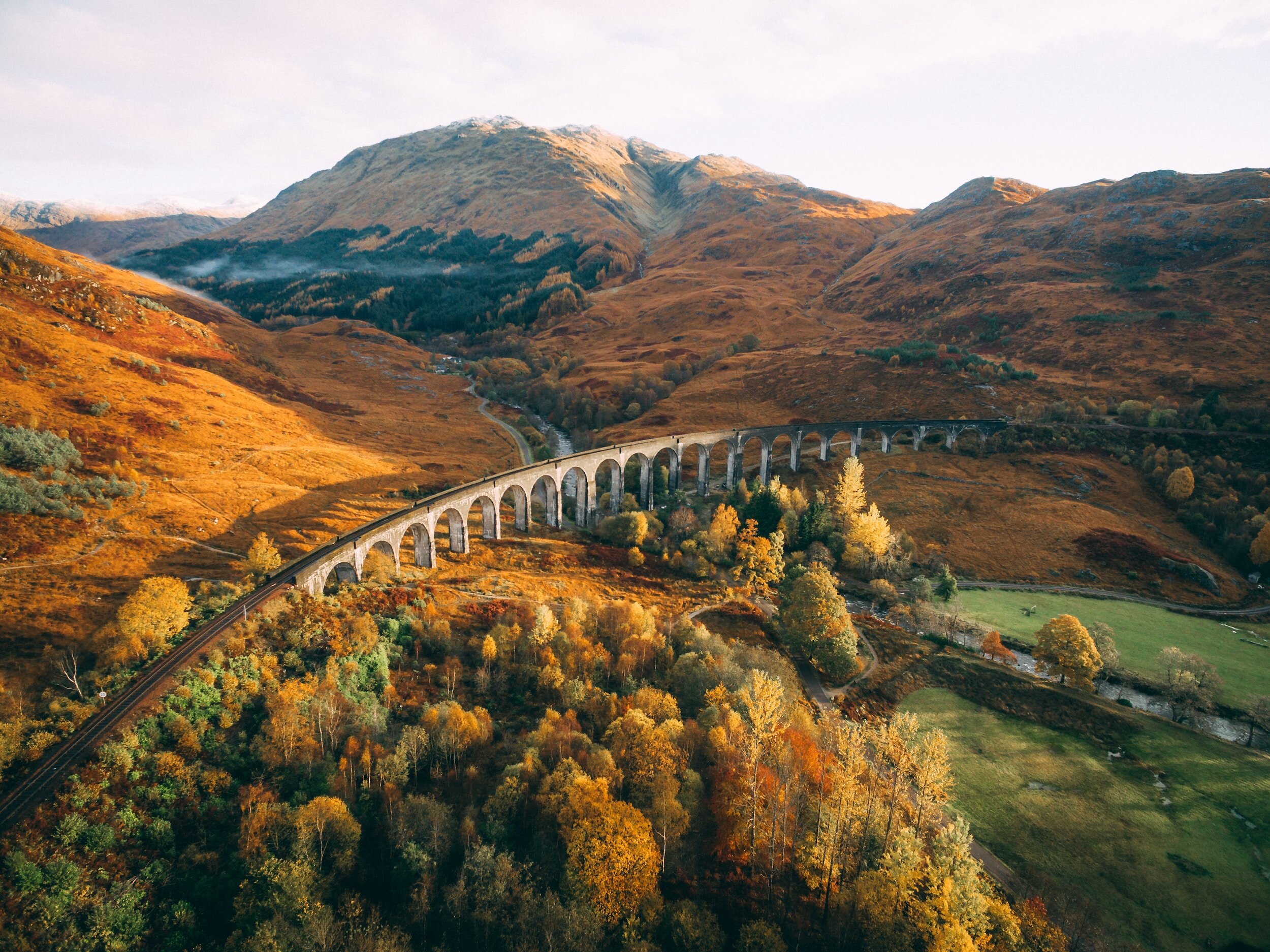
Walking the West Highlands way is one of the lowest carbon holidays available.
Scotland Adventure (7 days) - 0.09 tonnes of CO2e per person
Wilderness walking the West Highland Way is one of the most popular adventure itineraries in the UK. It’s a 95 mile hike from Milngavie on the outskirts of Glasgow to Fort William in the Scottish Highlands. The carbon footprint of this trip is kept to a minimum by travelling by train to the start of the trip and taking the train home again.
💡 Carbon emitted for a family of four: 0.36 tonnes of CO2e
What does all this mean for the future of holidays?
To meet the climate targets set out in the Paris agreement, we need to get our personal footprint down to under 2 tonnes per year by 2050. In this scenario, none of the trips in the high or medium carbon category would be possible. Whilst the footprints of these trips should come down as the world decarbonises, long haul air travel still has a VERY long way to go. Even the increase in use of Sustainable Aviation Fuel won’t reduce its carbon footprint as much as will be needed to meet Net Zero targets.
