

Are Heat Pumps & Solar Panels Worthwhile?
Two ways to decarbonise your home are to improve energy efficiency and switch to renewable energy. Our very own carbon-busting superstar, Helen, has done both at her Oxfordshire home in the UK. She has installed an air source heat pump to replace an old oil boiler and solar panels to harness the power of the sun. Let’s dive into the nitty-gritty of running these systems, the costs, how long it takes to get a return on investment and the emissions reductions Helen’s family have generated.
Background
Helen and her family live in a 1960s bungalow that has been converted into a standard-sized, detached 4 bedroom, 2 storey house. When they moved there in 2018, there was a 20 year old oil boiler (their village isn’t connected to mains gas) that needed too much TLC Having installed a heat pump in their previous property, it was an easy decision to replace the boiler with an electric air source heat pump, particularly as the house was already well insulated.
The air source heat pump
Back in 2019, the installation was straightforward with no planning permission required. The unit makes very little noise and needs next to no maintenance.
Running the heat pump
Helen opted for an air-to-water heat pump (which is more expensive than one that just pumps air into your house). The system works by drawing cold air from outside and, using the opposite system to that in the back of your fridge, turns it into heat and transfers it to the water system that runs through the (large) radiators. It also provides hot water for showers and could be used for underfloor heating too if you have it.
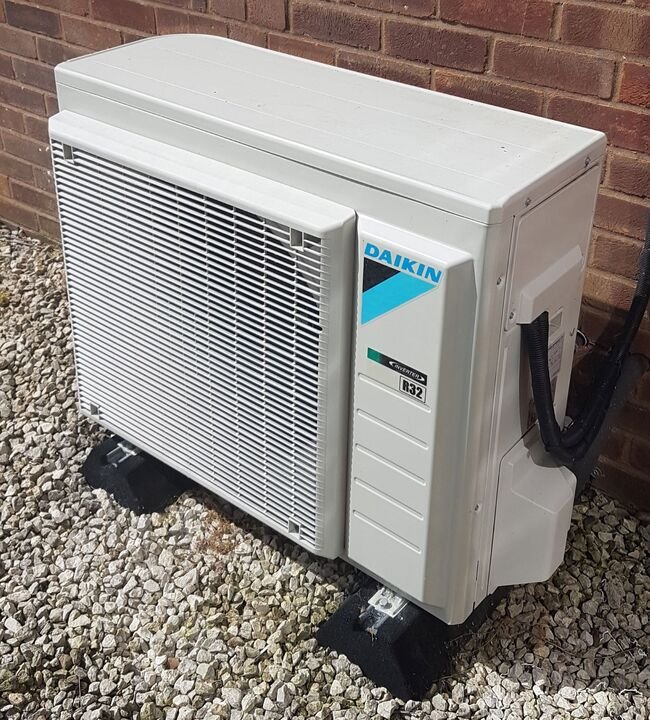
Ta daaa! Helen’s heat pump
Helen’s family set the water temperature to keep the house at a constant air temperature of 18-18.5°C as the heat pump is most efficient when it’s running constantly. The system keeps the radiators warm rather than making them hotter and cooler. This means you can’t whack the heating up when you come in from a walk on a cold day but it does maintain an ambient temperature.
Heat pump costs and return on investment
At the time of purchase, they benefited from a government-run ‘domestic renewable heat incentive’ scheme* which pays them £1,560 annually for 7 years. With the heat pump costing £11,000 including the installation, they will have a near 100% return on investment in that time.
*This scheme is closed to new applicants. Other grants are available, although mainly for low income households.
When it comes to the electricity costs, things are a little stickier. Despite the fact that the heat pump is more efficient than the heat pump, the cost of the electricity to heat the water and the house is about £50 more per year (at current prices). That said, the boiler needed regular maintenance so would have likely worked out more expensive in the long-run.
Heat pump emissions reductions
Now to the juicy part (for us anyway).Switching from her old oil boiler to the electricity-powered heat pump saves Helen an average of 2,596 kgs of CO2e per year. That means, since installation, Helen’s family has already saved nearly 13 tonnes of CO2e - chapeau!
(FYI, this is way more impactful than purchasing offsets and in this case, potentially cheaper too!)
The Solar Panels
Following her Carbon Literacy pledge to install solar panels on her house, Helen had 10 panels fitted on a south facing roof (although you don’t have to have a south facing roof these days). They also have one small (0.75 kWh) battery. The electricity they generate they can use for free. Any surplus each day is sold back to the grid through their contract with Octopus Energy.
Sidenote: if Helen’s family didn’t have the heat pump set up heating the water, they could divert excess energy to heat water for showers.

10 solar panels in all their glory on a sunny day
Running on solar
Your habits do change when you have solar panels. In order to benefit from the ‘free’ electricity, you will want to run energy intensive appliances during daylight hours (unless you have a huge amount of battery storage). The dishwasher, electric hob, kettle and power shower are the most energy intensive appliances. Running the washing machine on a cold wash doesn’t use much energy at all.
Word of warning: trying to use up as much free electricity as possible is VERY addictive
Solar panel costs and return on investment
The 10 solar panels cost £8,000 with fitting and are already saving them money on their electricity bill since Octopus Energy pays them 15p per kilowatt hour (kWh) (2024 rates) for any surplus they sell back to the grid. Based on the money they are saving on their electricity bills and the income from selling surplus electricity (around £850 per year, they should break even on their investment in 9.5 years.
Solar panels emissions reductions
Helen’s family were already on a renewable energy tariff so their electricity emissions were more or less zero. But for most people in the UK, this switch would typically reduce emissions by 500 kgs of CO2e. For Helen’s family, the fact that they are using less renewable energy from the grid as well as selling renewable energy back to it means that other people are benefiting. For them, the savings are around 900 kgs of CO2e per year so Helen’s family have saved roughly 1,350 kgs of CO2e to date.
So are heat pumps and solar panels worthwhile?
Yes and yes. They are worth it from an emissions and a financial perspective. The heat pump, once the capital cost has been paid back, costs about the same (or perhaps a little less) to run as an oil boiler. The solar panels will definitely save the family money once the investment has been covered and will continue to reduce emissions by allowing them and others to benefit from the renewable energy they generate.
However, whilst the carbon savings are fantastic and the financial savings are good, it’s still not a perfect solution. The solar panels generate most electricity in the summer when our side of the Earth tilts towards the sun. Meanwhile, the biggest drain on electricity is during the winter when they are using the air source heat pump for heating.
So it’s not perfect, but we need more people, households and businesses taking lots of great (albeit slightly imperfect) action.
Helen’s next plan is to add more battery capacity to the house in order to use more of the solar generated electricity in the evenings. She is also considering a wind turbine to increase the amount of electricity they can generate in the winter months to power the heat pump.
How about you? What can you do to bring your emissions down?
PS. We cover business and personal emissions reduction actions in our Carbon Literacy courses. Find out more information here.
