

How to Avoid Greenwashing
With an increase in customers willing to pay more for sustainable products and services, greenwashing (intentional or otherwise) is rife. Here, Heather Davies, takes you through greenwashing, what it looks like and how, as a company, you can avoid doing it.
What is greenwashing?
Greenwashing is misleading customers, giving them the false impression that a product, service or business as a whole, is more environmentally sound (or less environmentally damaging) than it is.
Intentional greenwashing is where companies set out to deceive customers, but I’d argue that this is a minority of cases. The vast majority of greenwashing is unintentional. This unintentional greenwashing can take several different forms:
Broad claims: such as ‘green’, ‘sustainable’, ‘eco-friendly’. These terms are unquantifiable and mean something different to different people.
Unsubstantiated claims: where a company provides no information to back up what they are saying
Omitting/hiding important information: for example saying a product as a whole is natural when the contents are but the packaging isn’t.
Ambiguous claims: these are claims that could be open to misinterpretation such as using the term ‘compostable’ when there is a big difference between home and industrial compostability.
Using green/natural colours and imagery: to give the impression that something is sustainable when it is in fact not.
It is important to know that the UK is clamping down on greenwashing. Two agencies (the Competition Markets Authority and the Advertising Standards Agency) work side by side and are leading investigations into claims and forcing companies to remove ads that do not comply.
Similar agencies exist in other countries, so be sure to look up their guidance if you are advertising your products or services abroad.
Examples of greenwashing
The first is an example of a broad and ambiguous claim and it’s from Alpro, on their oat milk which they claimed is “good for the planet”. The ASA upheld the complaint because it was too vague and there was not enough context for customers. Find a link to the ruling here.
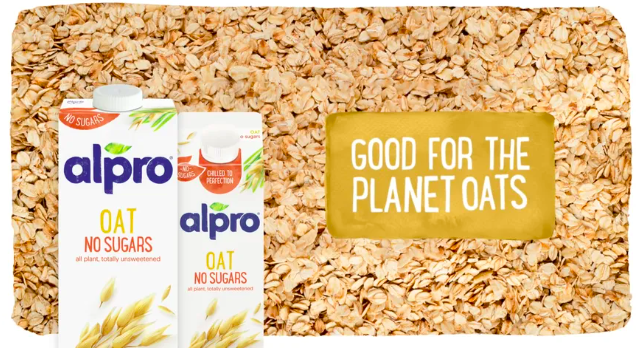
Alpro ad that they were forced to remove by the Advertising Standards Authority
The second comes from HSBC who fell foul of the rule about omitting/hiding relevant information. In their ad, they claim that they will invest $1 trillion to help their clients transition to net zero and in another they said they’d planted 2 million trees to lock in 1.25 million tonnes of CO2e, completely failing to mention their significant contribution greenhouse gas emissions thanks to their oil and gas clients whose yearly emissions will dwarf these numbers. They were forced to remove the ads. Here’s a link to the ruling.

HSBC were forced to remove this ad.
Our third and final example comes from a well known ecommerce site that stocks a wide variety of items. One such item, baby wipes by a company called Q River, claimed to be 100% biodegradable within 15 days. The ASA investigated the complaint and found that the tests used to substantiate this claim were not fit for purpose as they were carried out in optimal conditions and not average household bins, compost heap or landfill conditions. They also concluded that customers could be led to believe that the wipes would have no negative impact on the environment once disposed of. Here is the full ruling.
So as you can see, the authorities mean business. If you’re found to be greenwashing the effects can be damaging. Not only could you have to foot the cost to change adverts and packaging (and face fines in some countries) but your brand reputation is on the line.
8 tips to help you avoid greenwashing
In some ways this isn’t rocket science, but it does require you to have an excellent knowledge of your product or service at every step of its life cycle.
To avoid greenwashing:
Tell the truth, be transparent
Be accurate and unambiguous
Take the full lifecycle into account from production through packaging and transportation to disposal
Do not omit or hide information
Back up your claims with valid information
Give context to your claims using fair and meaningful comparisons
Avoid generic jargon (green, sustainable, eco-friendly)
Beware terms that could be misinterpreted (recyclable, compostable, natural)
The best test to check your copy or advertising for greenwash is to put yourself in your customers’ shoes (you will need to try to forget everything you know about this product). This is hard to do in practice so I would recommend testing your copy and your ads on people before going public. If your content raises more questions than it answers then you could fall foul of the Green Claims Code.
Communicating your net zero target and plan without greenwashing
We haven’t really covered it above but communicating your net zero target is one way you could potentially fall into the trap of greenwashing. How? By announcing a target without any context or plan. Simply saying that you’re going to be a Net Zero business by 2050 isn’t enough. There’s too much information missing. So how would you go about this?
Firstly, communicate the business’s intention and motivation for your net zero target. Secondly, put together some information about the starting point, such as what the company’s emissions or carbon intensity figure is currently. Thirdly, outline the steps the company plans to take to achieve its targets including where any particular challenges lie.
The next stage is to maintain communications around your plan. Talk on an ongoing basis about what is going well, your wins, what is moving more slowly than you hoped and what else you need to do to ensure you achieve your goal. This will help educate your customers and suppliers and will build a level of trust.
If you have missed your reduction targets, we would encourage honesty about why, rather than hiding or trying to bend the truth.
Talk to your customers in language they will understand and explain any terminology they may not be familiar with. Use meaningful comparisons (e.g. that’s equivalent to a return flight to New York). Don’t bury your message. Communicate it in ways that your customers are likely to engage with. For some companies that’s via social media, for others, on product labels, via reports, newsletters and through the company website.
Examples of good communication around Net Zero
In our view, these organisations have done a great job of communicating their net zero targets and commitments:
If you need help constructing and communicating your Net Zero plan without greenwashing, get in touch.
