

How to Create A Carbon Budget
To limit global warming to 1.5℃ and help prevent the catastrophic effects of climate change (wildfires, drought, flooding, food shortages, mass migration etc) we all need to reduce the amount of greenhouse gas emissions we are producing. This is often easier said than done, even if your business has set a Net Zero target. But what if you could manage your organisation’s emissions like you would a financial budget? The way to do it is with a carbon budget, but what is it, how does it work and how do you implement one?
What is a carbon budget?
A carbon budget is the finite amount of greenhouse gases (expressed as CO2e - carbon dioxide equivalent) we can release in order to limit global temperature rise.
In 2021, the remaining global carbon budget according to the IPCC report was 400 billion tonnes.
This MCC Carbon Clock shows how much time is left:
Why set a carbon budget for your business?
Budgeting carbon doesn’t sound very sexy, but creating a carbon budget provides a clear framework for decision-making, in the same way a financial budget does. Four other compelling business reasons for implementing a carbon budget are:
to keep to your net zero target
to stay ahead of any upcoming legislation
to become more climate resilient and future-proof
to be able to forecast future emissions
How to work out your organisation’s carbon budget
Typically a company will need to reduce its emissions by 90% from its baseline year before 2050 in order to achieve Net Zero.
Here’s how to calculate your budget:
Work out the size of your annual carbon footprint (all scopes) to get your baseline year - we can help with this part
Establish your organisation’s Net Zero target date.
Calculate the total amount of carbon dioxide you would emit between now and your Net Zero date (see graph and explanation below).
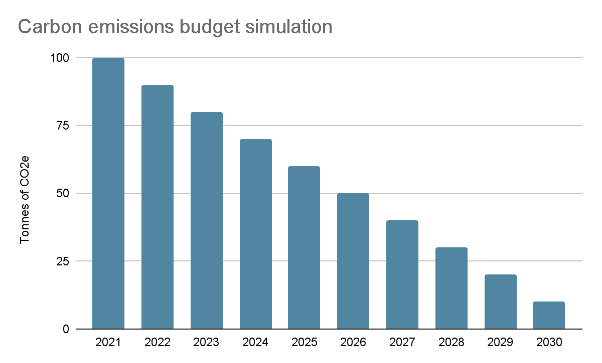
Plot out your annual emissions from your baseline year (say 2021) to your net zero date (in this case 2030). If your baseline year's emissions were 100 tonnes of CO2e and your net zero target date is 2030 (by which time your emissions need to be 90% lower), that means your next year's emissions will need to be 90, and the year after that would be 80. This continues until your net zero date when you’d have reduced to 10 tonnes of CO2e. You would then add up all of the years you have left. (90+80+70, etc), which in this example is 450 tonnes. THIS is your carbon budget.
Sharing the carbon budget and assigning responsibility
Your next job is to split that budget by region / department. Use the division that makes the most sense. Basing it on how your financial budgets are split is an obvious way to do this.
Team training is arguably the most vital step within the whole process. Before communicating the budget internally, it is important to train your team. Carbon Literacy Training is a good framework for this (and a workshop we can provide). This will help your employees understand why a carbon budget is necessary, what it relates to and how they, in their role, can help the business reduce emissions and stay within budget.
Once they have this understanding you can communicate the budget to them and tell them how it will work in practice. Do be sure to manage expectations within the company though, year 1 is always the hardest.
Sticking to a carbon budget
Once your budget is in the hands of your business leaders, you need to help them stick to it. You may need to come up with some rules (like you would with a financial budget) to address what happens if a department goes over budget. Do you take it off the next year’s budget? Do you need to keep some of the budget aside to account for any overspend?
You will also need to have a system in place to monitor emissions against the budget. Making your accounts department responsible for the carbon budget could make sense, thanks to their their skills and experience in monitoring financial budgets.
Making the carbon budget part of the executive team’s KPIs and linking this to remuneration is a key way many companies are incentivising their leadership team to meet climate targets.
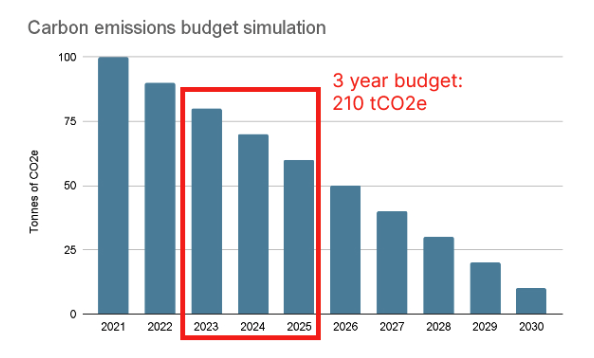
Rather than giving business units a year on year carbon budget to stick to, you could choose to give them a larger budget spread over a longer period of time. Giving a department a 3 year budget to stick to, for example, can allow them the flexibility to make more strategic decisions and put longer term emission-reducing strategies in place.
We hope you found this article helpful. If you would like to discuss how a carbon budget could work in your business and get some help measuring your carbon footprint, setting your net zero target and / or implementing one, do get in touch.
