

Melting Mountains: The Paradox of Ski Resorts and Climate Change
“Mont Blanc has become a symbol of climate change”, says the UNFCCC.
ecollective has estimated that over 8 million skier days could be spent at resorts each year that don't have a carbon reduction plan.
The mountains are being affected by climate change at a faster rate than other environments. Rising temperatures are melting snow and glaciers, increasing the avalanche risk and ski seasons are a month shorter than in the 1970s. Drought and higher temperatures also affect the resorts’ ability to make artificial snow.
A lack of snow has led to some resorts dismantling their lifts and returning their slopes to nature for good resulting in a huge loss of economic activity for the villages concerned.
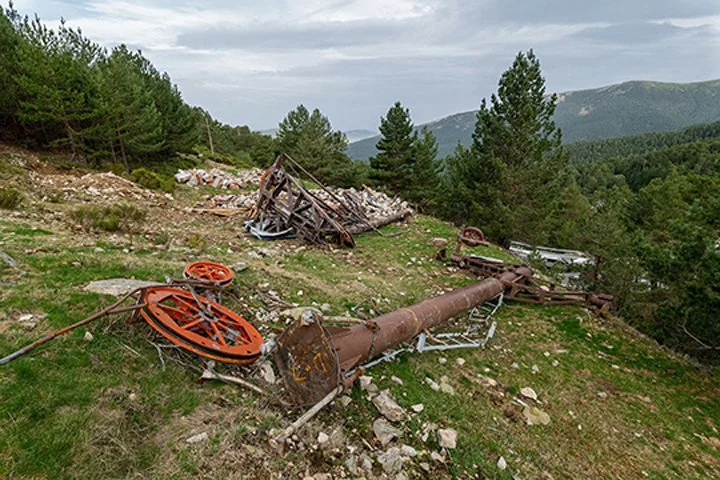
Dismantled ski lift parts awaiting removal (photo credit: Bloomberg)
The carbon footprint of skiing and snowboarding
There are various analyses out there, but roughly speaking, the carbon footprint of a ski trip looks like this (thanks to Protect Our Winters for the visual):
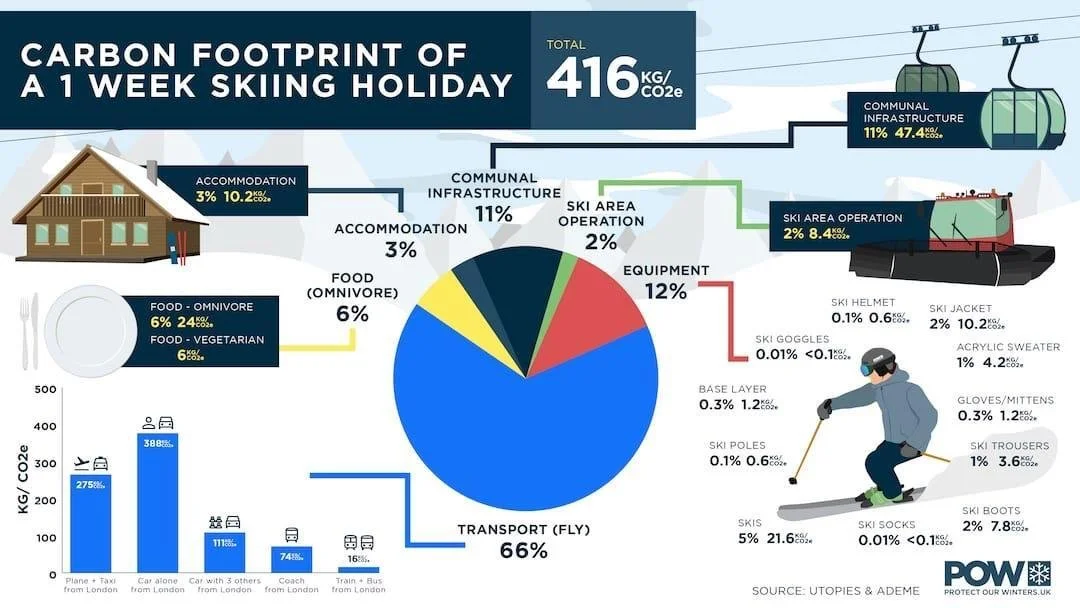
As you can see, the activity of skiing is seriously low carbon with lift infrastructure usually powered by electricity from hydroelectric plants in the mountains. The carbon hotspot of skiing lies in the travel to resort which accounts for up to 70% when skiers take flights and minibus transfers to and from resort.
So what are resorts doing to protect their future?
A little, but not enough. We started with the basics, by looking at which resorts are measuring their Scope 1 & 2 emissions.
👉 Find out which of the top resorts are measuring and reporting their carbon footprint here.
Our research identified some good news too. Most resorts are aware of the need to run more with a lower carbon footprint and are taking important steps like:
Switching to renewable electricity
Using less energy per skier by being more efficient.
Replacing diesel buses with electric in-resort shuttle buses
This is good, and we definitely encourage these actions, but they are ignoring the rather large woolly mammoth in the corner…the fact that so many visitors arrive by plane.
👉 Did you know? Travelling by train rather than plane, reduces a skier’s travel-related carbon footprint by two thirds.
There are a tiny handful (a pinch really) of resorts and holiday operators taking responsibility for the travel aspect with incentives and information about travelling by train rather than plane. They include:
Montagne Verte for their Alpine Express Pass in Morzine - the best incentive scheme we’ve seen
La Rosière for their eco-friendly travel offer - get a discount off your lift pass if you travel by train
Inghams for prioritising information about ski holidays by train
Ski Solutions for sharing information about ski holidays by train
What should more resorts be doing (in our view)?
Our call to action for all resorts is to MEASURE their carbon footprint. All of it, including Scope 3 emissions. From there, the most effective actions they can take to reduce their emissions will become startlingly clear.
If you work for a ski resort and would like to do this with us, we’d be only too happy to help. Contact us here.
We have conducted this research in collaboration with the wonderful team at Inghams. Why? Because they want to design low carbon ski holidays and identifying which resorts have a lower carbon footprint helps them to do just that.
