

5 Customer Strategies To Help Your Business Achieve Net Zero
With any Net Zero strategy, there are elements that are directly within your control and elements which are not but over which you still have a degree of influence.
Customer activity falls into the latter category. So what can you do to help your customers help you achieve your net zero target? We’ve ranked five techniques according to which we believe to be the most effective.
1. Remove high carbon options
This is simple and has a direct effect. Removing high carbon choices from your product or service means your customers can’t choose them thus immediately reducing your carbon footprint.
A restaurant, for example, could remove dishes containing beef since beef is the foodstuff with the highest carbon footprint per kilogram (ok, it’s not a strategy for the Angus Steakhouse, I admit).
An adventure company could keep land and water based adventures and remove sky-based activities like skydiving which requires a private plane.

Keep low carbon water and land-based adventures, cutting out higher carbon ones.
If you run an events business, removing single use stands for exhibitors would be a meaningful way to save you carbon.
2. Sustainable choice architecture
Making the low carbon options to be easy to choose and desirable whilst making high carbon options less attractive and more difficult to select. This is called sustainable choice architecture.
On a menu this could be putting the plant-based items higher up the page, having a featured meal deal that happens to be vegetarian or making plant milk for hot drinks the standard option. This means people have to search or ask for the less sustainable choice.
On a website, making features out of lower carbon products or services with customer quotes, ratings, photos and videos could persuade people of the benefits they would have from choosing the lower carbon options.
Making the higher carbon option more expensive could be another way to affect customer choices. A holiday company could design trips around train stations as opposed to airports.

Designing trips around train travel rather than air travel will help reduce your company’s carbon footprint
Reframing the message can also help. People tend to like to ‘follow the crowd’, it’s called social contagion and is a persuasion technique. To get people in hotels to reuse their towels a message worded along the lines of “90% of our customers are happy to keep their towel for the duration of their stay” is more effective than “Please reuse your towels to save the environment.”
3. Feedback loops
Feeding back to your customers the effect of their climate-friendly choice is a great way to reinforce the behaviour you want to see.
An example would be feeding back the carbon saving a customer has made by making a particular purchasing decision. Check out this example from Imperfect Foods:
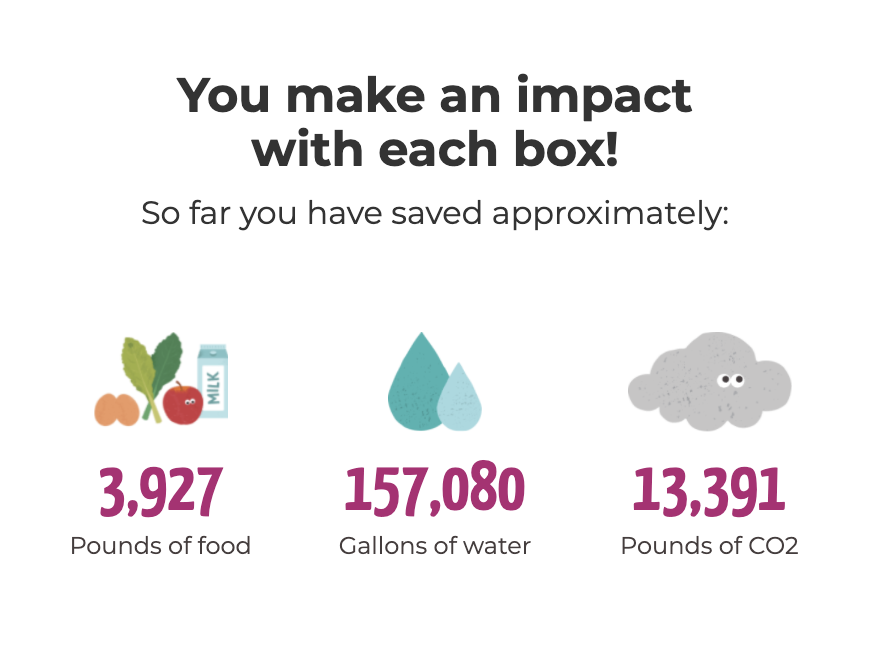
Imperfect foods tell their customers the positive impact of shopping with them.
Sustainability behaviour expert, Livvy Drake, has a great article on this subject with some helpful examples of this.
4. Carbon labelling
We are a huge fan of carbon labelling and talked all about it in a previous article. This is when you put a badge displaying the carbon footprint on your product.
Does this work in practice? It’s early days but carbon labelling does seem to be having an effect on customer choices. It also has an effect on your business too. By labelling your products you are taking ownership of their carbon footprints and are more likely to work to reduce them.
5 Education
You have your customers’ attention whilst they are in the process of buying from you so why not use some of that time to educate them on why the climate crisis matters. No greenwash, just some facts to help them understand the impact of their decisions. This hasn’t been proven to be super effective because people find it hard to reconcile climate statistics with their actions.
More pertinent education points could be around how to use your product efficiently and how to repurpose, upcycle or dispose of it properly at the end of its life.
So there you have it, five actionable customer strategies to help your business achieve its net zero or sustainability goals. Which one will you implement first?
As ever, for carbon measurement and consulting queries, drop us a line.
