

The Carbon Footprint of the Aviation Industry
Before we start, let’s address the elephant in the room: the aviation industry is, without a doubt, one of the hardest industries to decarbonise. In this article we’ll look at the emissions trend, what type of air travel these emissions come from and who is responsible for them. We’ll cover radiative forcing (if you haven’t heard of this, don’t worry, we’ll explain). We’ll tell you how to calculate emissions for air travel and discuss what companies and individuals can do to reduce their aviation emissions. Lastly, we’ll give you our view on what the future holds for the industry.
Aviation emissions trends
In 2018, CO2 emissions from aviation hit 1.04 billion tonnes. The covid pandemic lead to a drop in emissions but worryingly, they are expected to continue to grow over and above pre-pandemic levels in 2023-24. An Environment and Energy Institute study suggested that commercial aircraft emissions could triple by 2050 given the projected growth of passenger air travel and freight.
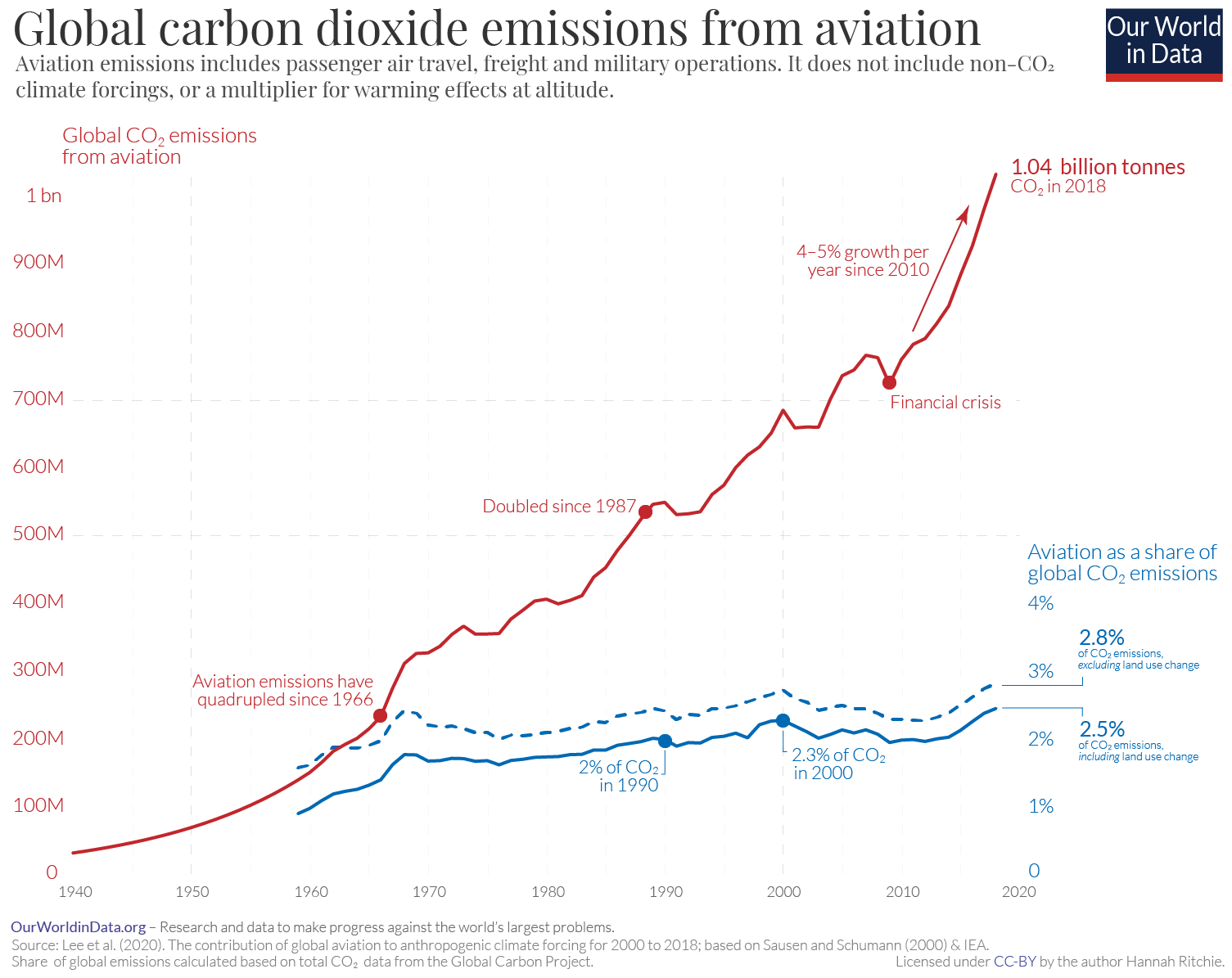
CO2 from aviation is still a growing problem.
Overall, aviation accounts for 2.5% of global carbon emissions, but when you consider other environmental effects (and radiative forcing), it actually accounts for 3.5% of global warming. This may not sound like a lot but it is significant. For context it is similar to the emissions of the whole of Africa (3.91% of the world’s emissions in 2021). This brings up another point, that just 1% of the world’s population is responsible for half of all carbon emissions from passenger air travel.
The different types of aviation emissions
Emissions come from commercial passenger travel, air cargo and private jets. In 2018, passenger transport represented 81% of global commercial aviation emissions and air freight 19%.
Private jet travel has a disproportionately large impact and this type of travel is on the rise. Private jets are 5 to 14 times more polluting than a flight by a commercial airliner. According to an article by Transport & Environment, a single private jet can emit two tonnes of CO2 in just one hour. For context, the average European has a carbon footprint of around 8.2 tonnes of CO2e per year.
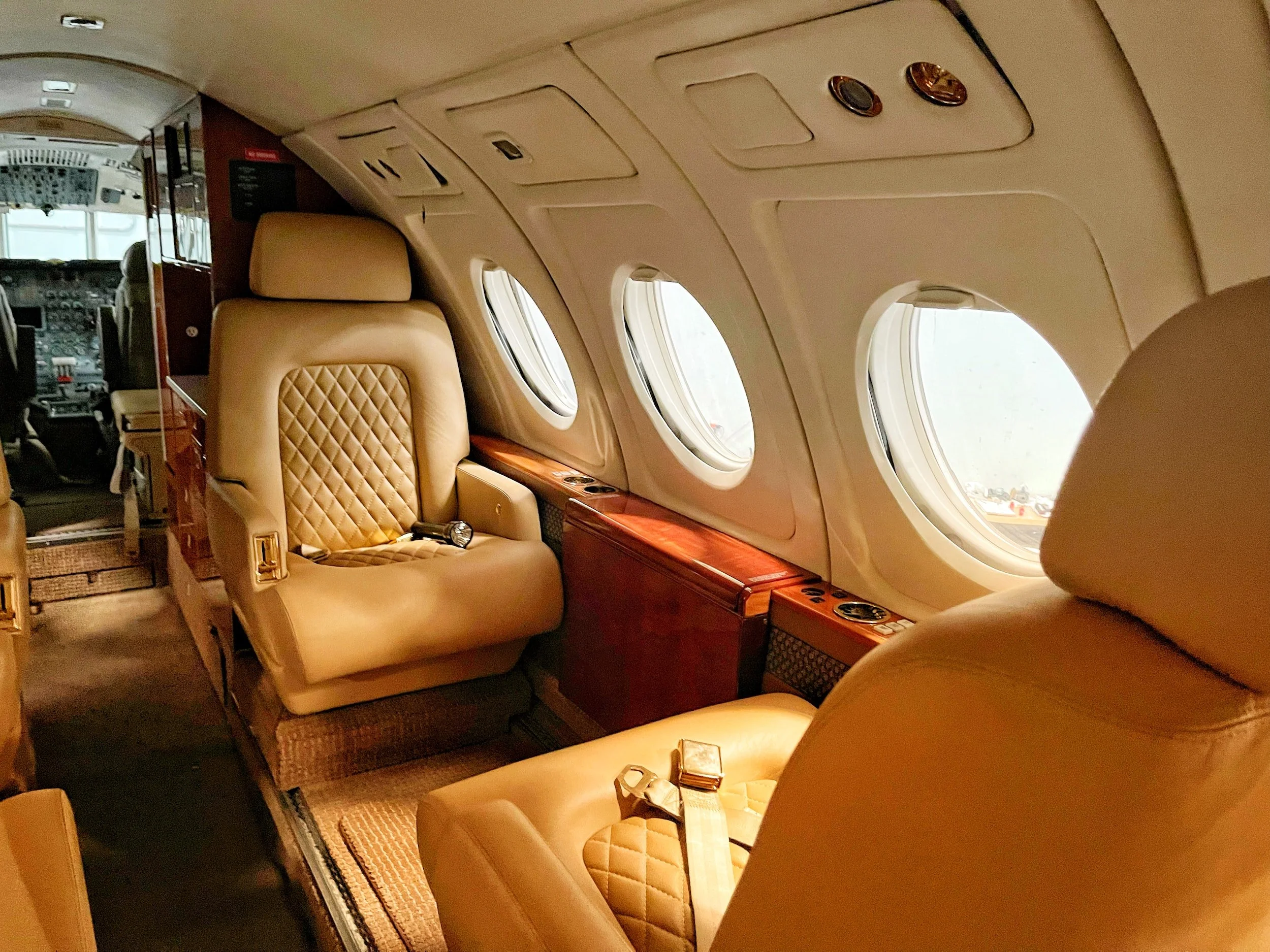
Private jets emit 2 tonnes of CO2 in one hour.
Aviation fuel efficiency has improved
This is good news. Whilst the number of passengers flying has dramatically increased since the 1950s, aviation fuel is 11 times more efficient than it was, which has kept emissions much lower than they would otherwise be. That said, they’re still high and projected to grow as the growth of customers is higher than any future efficiency savings.
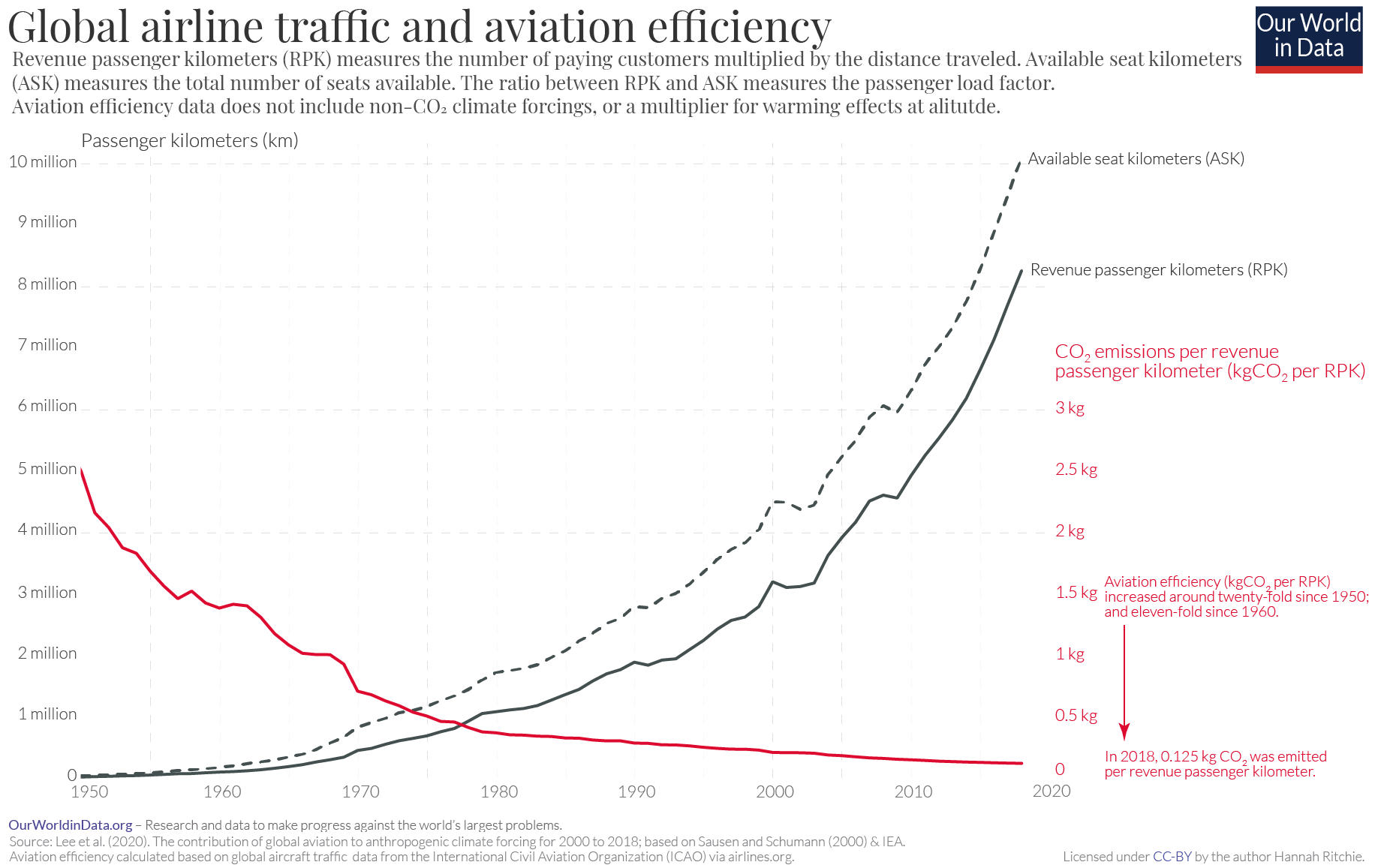
The red line shows emissions per passenger kilometre have declined over time, meanwhile demand and availability has risen (black lines)
Why do carbon calculators produce different results?
You may not have heard of radiative forcing before but it’s important to understand this if you’re calculating emissions related to air travel. In a nutshell, aviation fuel, burned at high altitude, has a stronger global warming effect than if the same fuel was burned at ground level because of reflected solar radiation and other atmospheric effects.
Many carbon calculators for air travel do not include it in their calculations which makes your air travel carbon footprint look lower than it actually is.
At ecollective, we always include radiative forcing in our calculations as this most closely reflects the effect of your company’s air travel.
The future of aviation
As you’ve already read, air travel is projected to increase. To help manage the associated emissions, the industry is working on new innovations including electric planes, planes that run on hydrogen, and sustainable aviation fuel.
Electric planes are typically battery powered and have electric motors powering propellers. They are still small with limited passenger capacity but are expected to become commercialised by 2028. As the battery is heavy, electric planes are only likely to carry out short haul flights.
Hydrogen planes are also an option for decarbonising the aviation industry that is being invested in by the biggest players. Hydrogen planes could hit the market by 2035.
Sustainable aviation fuel (SAF)
SAF can be produced from a variety of sources including used cooking oil, biomass, carbon capture and green hydrogen. It is sustainable in the sense that it is not produced from fossil fuels but does still produce some emissions. IATA says it can reduce air travel CO2 emissions by 80%.
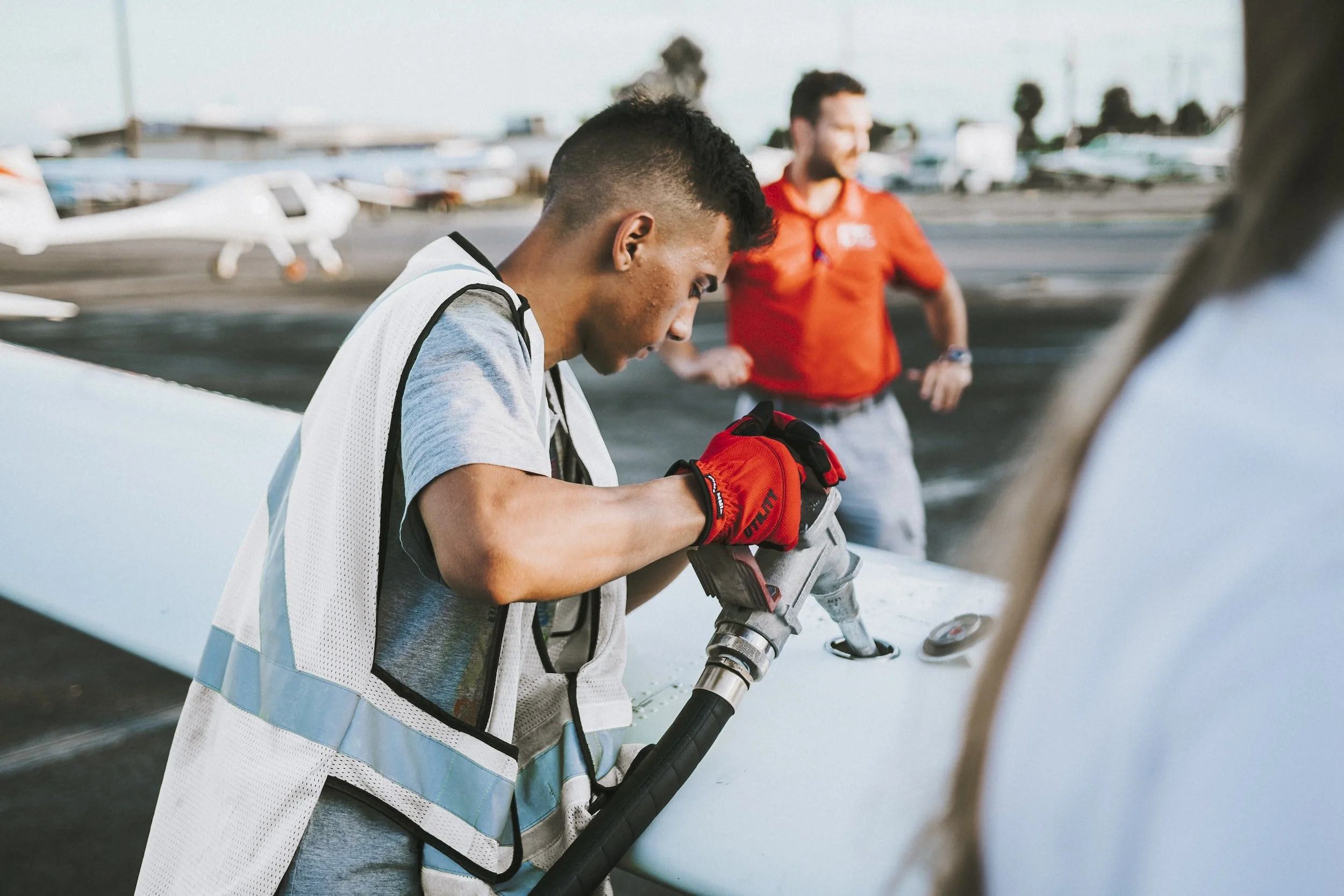
Sustainable aviation fuel can reduce emissions but is still not widely used.
IATA, the International Aviation Transport Association’s members, have committed to a Net Zero target of 2050. They explain how they will get there using SAF in this short video:
It is worth mentioning that SAF currently represents a tiny share (about 4%) of the aviation fuel market. It is more expensive to produce than fossil-based fuels and produced in smaller quantities which is why it is not more widely used. At present there simply aren’t the economies of scale to reduce the price which will have the inevitable effect of limiting the pace of its adoption.
How to calculate aviation carbon emissions
There are various carbon calculators freely available online. Tilted Map has written up a great article comparing some of the main ones.
A typical calculation for aviation emissions should look like this:
Air miles x air travel emissions factor x radiative forcing factor
At ecollective we take into account whether you are travelling by private jet or economy, business or first class. Why does the latter make a difference? Simply because there are less seats in business and first class. If the whole plane was economy class, the carbon footprint would be shared between more seats reducing the per person carbon cost. The added extras (rib eye steak, champagne, showers, bed linen etc) also play a part although we’ve never calculated this bit.
How you can reduce your air travel carbon emissions
The obvious answer is simply to stop flying, but we understand that this is not always possible or desirable so here are our tips:
Swap private jet travel for commercial
Fly shorter distances year on year
Choose train travel rather than flying
Travel economy rather than business or first class
If you must fly, fly direct
Compare airlines / aircrafts to choose the lowest carbon option
Set an annual business travel carbon budget
Conclusion
The airline industry is taking steps to decarbonise, but far too slowly. We need to understand the impact we are having by flying and start to change our habits too. If we can help you calculate your company’s travel carbon footprint and work out the best strategies for reduction, then you know where to find us.
