

Investing in Nature - A Case Study
When it comes to companies taking climate action, there’s a trend we see repeated time and again. Companies start with offsetting, the gateway drug of the sustainably minded board member. This involves estimating emissions and buying carbon credits to ‘compensate’ for them. The next step is a move into emissions measurement and reduction strategies like switching to renewable energy / reducing or changing travel habits / assessing suppliers etc.
Very few companies (so far) have involved themselves in direct nature protection and restoration.
(Ok, some carbon credits work to protect and restore natural environments but the company purchasing the credits has no direct control over how this happens or how effective it is.)
Naturetrek bucks the trend
Naturetrek specialises in wildlife holidays around the world. With birds, mammals and plants the focus of their trips, it’s no surprise they are committed to protecting the environment and limiting their impact as a company.
Even before measuring their carbon footprint and identifying reduction actions, Naturetrek took the relatively unusual step of buying its own land to either protect or re-wild. This wasn’t in a bid to offset their emissions or to replace reduction efforts, but out of a genuine desire to protect the environment.
Over 10 years ago, they started buying land to preserve a threatened cloud forest corridor in the Ecuadorian Andes. Thanks to its high levels of biodiversity (on a par with the Galapagos Islands), it is one of the 200 most important wildlife corridors in the world. They now own 1,715 acres of the corridor which is equivalent to 1,072 football pitches. As well as preventing development, researchers are discovering new species. Two new frog species have been found and named in the reserve, the Naturetrek Leaf Frog and Maryanne's Rain Frog, named after one of the co-founders of the business.
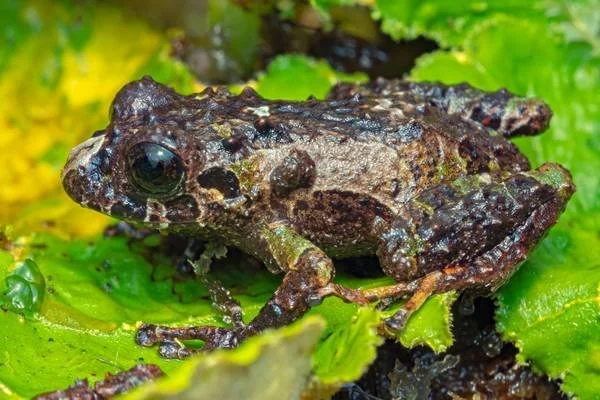
Maryanne's Rain Frog
More recently, the company has bought the 120 acre Macchietelle estate in Italy (east of Naples) with a mission to look after and rewild it for 30 years before entrusting the stewardship to two Italian conservation charities. Naturetrek will lead work to make the reserve a better habitat for the endangered Marsican bear. They will achieve this by removing fencing and other hazards as well as nurturing existing native fruit trees and planting new ones to provide them with food. Other work underway will help protect the Apennine wolf, amphibians and bees native to the area.
How much carbon is saved?
According to their calculations, the reserve in Ecuador alone has sequestered 83,000-166,000 tonnes of CO2e (carbon dioxide equivalent - all greenhouse gases combined) to date.
This goes a long way to compensating for the company’s total lifetime emissions (from 1987-2022) which ecollective has estimated as 170,000 tonnes of CO2e.
The benefits to Naturetrek
Whilst it’s clear Naturetrek has made these investments for purely environmental reasons, there are co-benefits too.
The parcels of land they own are assets which increase the value of the company.
Their land purchases demonstrate that they walk the walk (as opposed to just talking the talk about nature and the environment) and have helped them become a leading authority on nature-focused tourism.
It has helped attract and retain a passionate, nature-loving team.
No recurring fees from buying carbon credits.
It’s provided them with lots of interesting information and content to share with and engage their customers.
How nature protection benefits customers and staff
Naturetrek customers can take pride in enabling the company to purchase the land. £15 from every customer travelling long haul and £5 from every short haul passenger has gone into the kitty to fund the reserves. To date Naturetrek have raised £525,000 this way.
Whilst this is fantastic, an even better way of engaging customers is to let them see and experience the biodiversity of the reserves for themselves. The first intrepid explorers have already visited the site in Ecuador and the dream is to open a lodge at the reserve in Italy.
Naturetrek is involving more customers closer to home with their rewilding efforts at their HQ near Alton in Hampshire. Here, they have a 12 acre grassland reserve where they have planted 5,000 trees. Open days every month allow customers to visit and meet members of the team who take them on birding walks, to set moth traps, show them the wildlife pond, search for butterflies, orchids and more. They love it and so does the team. For the staff, it provides a beautiful location to enjoy lunch or take a break from their desks.
In addition to the tangible benefits, the team, who are all extremely environmentally-conscious, take genuine pride in working for a company that is committed to the important role of tourism in species conservation.
Customers can also take heart from the fact that company profits are not being used to line the bank accounts of wealthy shareholders, but are going back into protecting the planet they love exploring.
Protecting nature isn’t just for companies
Individuals can also buy land for the purpose of rewilding. Helen’s parents (one of ecollective’s carbon accountants) have done exactly this in their corner of Warwickshire. They bought 4.5 hectares (around the size of 9 football pitches) of fields near their house which were for sale, preventing them from being developed. They are now home to 4 friendly alpacas, hundreds of metres of biodiverse hedgerows and 1.2 hectares of native broadleaf and Scots pine trees thanks to their planting efforts.
You don’t even have to buy land. If you have a garden, why not re-wild part of it like Heather’s parents have done? They turned their unused front lawn into a wildflower meadow and are constantly surprised at the different species of plants that pop up at various times of the year. It’s a haven for bug life too.
How can your company invest in nature?
You’ll need money. This could be surplus cash reserves that would otherwise be taxed, distributed to shareholders or roll over into next year’s budget. Or you could raise money through customer initiatives like Naturetrek has.
You will also likely need to work with partner organisations. Naturetrek works with established charities and nature protection organisations to help them achieve their goals and be their eyes and ears on the ground.
Want to know how much land your company should re-wild?
Read more about Naturetrek’s reserve in Ecuador here.
