

Measuring Your Company’s Carbon Footprint - Which Option is Best?
DIY VS Carbon Calculators VS Carbon Consultants
The board of your company has taken the unanimous decision to measure its carbon footprint and charged you with the task. But with a variety of options open to you, how should you go about it? This article aims to demystify the options and help you determine which will be most suitable for your company. Looking at seven criteria (time, cost, accuracy, insight, support, strategy and difficulty), we evaluate measuring using the DIY (do it yourself) method, using a carbon calculator and working with a carbon consultancy (like us). Don’t worry, we’ll do our best not to be too biased.
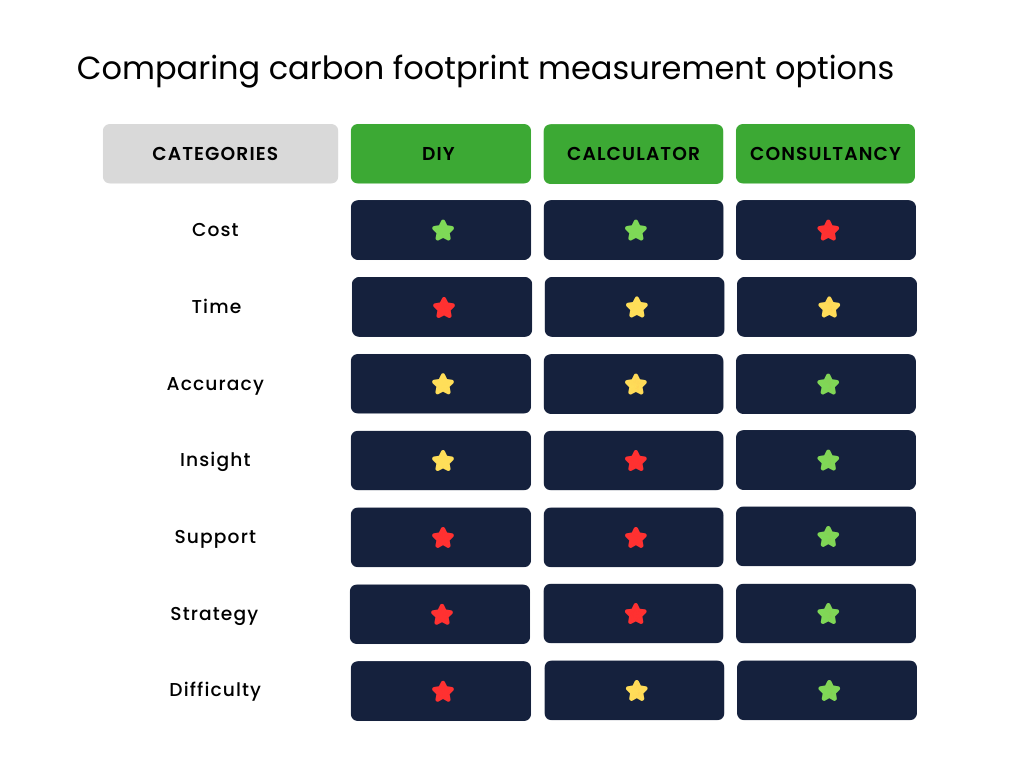
Our quick comparison of carbon calculation options
DIY carbon measurement
At the outset, you might consider measuring your company’s carbon footprint yourself. After all, how hard can it be? It’s just data multiplied by conversion factors, right?
🟢 Cost: This is the cheapest option on the face of it meaning it’s not going to cost you cold hard cash. But time is money too and this is a project that can drag you down rabbit holes if you’re not careful (believe us, we’ve been there). But if you have a yawning time slot to fill and a love of spreadsheets, then by all means crack on.
🔴 Time: Trust us, if you have never measured a footprint of a business before, it will likely take you a VERY long time. It is like learning a whole new language. A language that evolves every 12 months.
🟡 Accuracy: This is dependent on how well you do the job so it’s difficult for us to give an accurate score here (sorry!). Over the last few years we have seen the good, the bad and the ugly.
🟡 Insight: How accurate you are with your calculations will determine how useful your insights are.
🔴 Support: You’re on your own (unless your best mate is a carbon consultant).
🔴 Strategy: If interpreting company carbon footprints to come up with viable strategies for reduction isn’t your day job, you may to struggle with this.
🔴 Difficulty: Somewhere between hard and impossible.
Finding reliable and up to date conversion factors for everything, reading the data and coming up with meaningful strategies involves a lot of work. If you do want to give it a go, there are resources on the WWF website, UN and DEFRA sites. Maybe sign up to our newsletter too.
Using a carbon calculator
Online carbon calculators do what they say on the tin. You input your company information to a platform containing conversion factors and it provides you with the amount of carbon your company has generated.
🟢 Cost: Many carbon calculators online are free or charge very little (from £100 per year), but there’s a catch. These calculators are often set up to encourage you to spend money on offsetting, which costs money and doesn’t have the effect of reducing your carbon footprint.
🟡 Time: Using a platform should be considerably more time efficient than trying to do the job yourself since the conversion factors have already been gathered.
🟡 Accuracy: Beware, not all regions and industries are adequately covered by all platforms. Some are US focused and therefore only contain US conversion factors, others will not be detailed enough for your sector or activities. Also, emissions calculations could be based on spend, which is the least accurate calculation method.
🔴 Insight: Insights should be nuanced and relevant to how you run your business. Most online calculators will say spend less on things and your footprint will reduce (which is totally true), but you don't need to go through the whole process to be told that.
🔴 Support: You may get an ‘account manager’ when you begin working with a carbon calculator but not always and they are unlikely have much time to talk you through the process and the outcomes.
🔴 Strategy: Any recommendations made by a platform are likely to be generic. It will be up to you to come up with a reduction strategy that will work for your organisation and put it into action.
🟡 Difficulty: 5/10 - some platforms are more user friendly than others. Technology aside, one of the most difficult aspects of any carbon measurement project is gathering the data from your company systems (or collating it, if no system is yet in place).
If this is your chosen route, Greenly has an article about the best carbon calculators (in their opinion).
Working with a carbon consultancy
Carbon consultancies will have their own system (adhering to GHG protocols) for calculating your company’s carbon footprint. They will prompt you to provide data and will often share templates and techniques for gathering it. They will be on hand throughout the process, explaining their methodology, ironing out any issues and, thanks to their decarbonisation and industry knowledge will be able to help you identify and enact a meaningful carbon reduction strategy.
🔴 Cost: Yes, this is the most expensive option but you get what you pay for. Working with a consultancy usually costs from £1,000 upwards. But when it comes to long standing value, consultancy projects done right are second to none as they work to solve the core problem, compared to companies and calculators that sell offsets which represent a false economy.
🟡 Time: We’re not going to lie, any carbon footprinting project takes time. Your time on this project will mostly be required to source and share the information from your business the consultancy will use to calculate your carbon footprint. It typically takes between 4 - 6 weeks to measure your entire footprint in detail.
🟢 Accuracy: The value of what you pay for can be found here. Accurate calculations lead to the most nuanced and relevant insights upon which to build your reduction strategy.
🟢 Insight: See above. Accurate calculations teamed with industry and decarbonisation expertise means you’ll receive insight that, if acted upon, should lead your business directly to Net Zero.
🟢 Support: A consultancy worth its salt will be on hand to walk you through the whole process and should leave you with a bespoke carbon calculator that you can use to base business decisions upon. They will take care of the most difficult aspects of the project and will provide support for any areas you might stumble over. They may even provide additional services like carbon labelling, Carbon Literacy Training and help you communicate your plan.
🟢 Strategy: This is where working with a consultancy should pay dividends. The reason for calculating your carbon footprint is to identify the opportunities for emissions reduction. A carbon consultancy will work with you to set your net zero target (the date by which you will aim to reduce your emissions by 90% or so) and, using their knowledge and experience, will suggest the best short, medium and long term strategies you can employ to achieve it.
🟢 Difficulty: In this scenario, it’s the consultancy’s job to take the strain, making it the least difficult option of the three as they (we) do the heavy lifting.
So where does that leave you? Don’t forget that working out how your company can make profit with a smaller and smaller carbon footprint is going to be one of the biggest challenges over the coming years.
To be completely honest, we partly created this article due to a number of clients saying they had skipped the DIY option and came straight to us. Here’s a recent quote from one of our clients:
ecollective took, what was for us, an overwhelming project and guided us through it with patience and ease. We now have the knowledge and tools to make real and measurable change. It was a pleasure to work alongside Charlie and Myrea, and we look forward to developing our partnership year-on-year.
Nardia Sullivan, Wild Frontiers
If you’d like to discuss your carbon measurement and reduction project, get in touch.
